Skip to content

Opening hours

English
Bio-creative rapid orthodontics

Techniques we use

At a glance

What this covers
A target approach to moving selected teeth
Before you decide
Your treatment plan depends on your teeth and gums.

There are four techniques, chosen to suit the condition of your teeth.

01. Treatment using the C-implant

The C-implant has a two-part structure, a screw and a head — think of it as a very small implant. We normally use an 8.5mm C-implant, placed between the teeth. Placement causes little discomfort. Once in place, it gives us a fixed point from which to pull or push teeth.
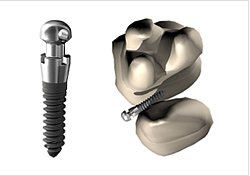
The C-implant — screw and head — beside a crown model
The device
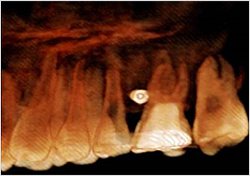
Radiograph showing a C-implant placed between the roots
Radiograph after placement
The C-implant and a radiograph after placement
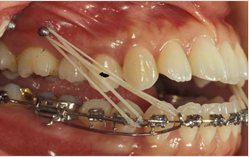
Elastic running from the C-implant to draw the front teeth back
Drawing back with elastic
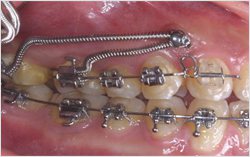
Wire from the C-implant pushing teeth, seen from the side
Pushing with wire
Moving teeth with the C-implant

02. Treatment using the C-tube

The C-tube has been nicknamed the fire-fighter of orthodontic devices, because it is used for so many purposes. It is made of titanium, and the 0.036-inch tube on its upper part is designed to take a wire.
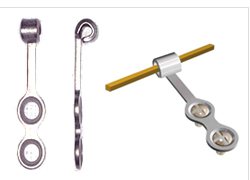
The titanium C-tube and its placement driver
Device and driver
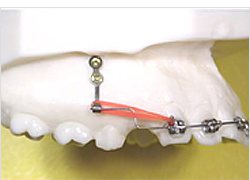
A C-tube placed on a model with a wire connected
Placed on a model
The C-tube and a placement model
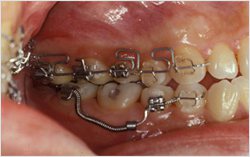
A wire from the C-tube uprighting a molar
Uprighting a molar
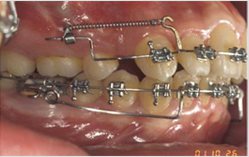
Teeth moved using the C-tube, seen from the side
Tooth movement
Moving teeth with the C-tube

03. Treatment using the C-plate

The C-plate is a cross-shaped mini-plate used mainly on the inner surface. It lets us carry out lingual orthodontics more simply and more efficiently.
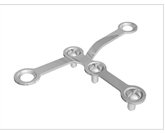
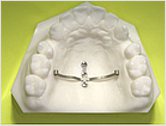
The C-plate, a cross-shaped mini-plate
The device
A C-plate placed in the palate on a model
Placed on a model
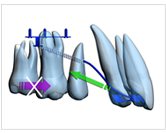
Diagram of the direction the front teeth move from the C-plate
Direction of movement
The C-plate, a placement model, and the direction of movement
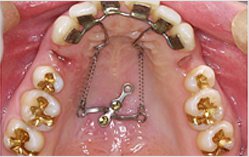
Lingual orthodontics using a C-plate placed in the palate
Lingual treatment
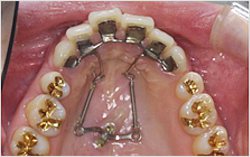
Teeth moved with a wire connected to the C-plate
Tooth movement
Lingual orthodontics using the C-plate

04. Bio-creative surgical orthodontics (BSO)

BSO stands for Bio-creative Surgical Orthodontics. We use it for older patients and for cases where tooth movement would otherwise be limited. In some cases a minor surgical step under local anaesthetic can speed movement up and widen the range of movement available. There are five solutions, Type A through Type E.
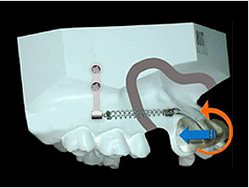
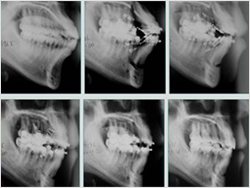
Model fitted with the appliance used in surgical rapid orthodontics
Appliance on a model
Lateral radiographs comparing the five solutions, Type A to Type E
Type A–E compared
The BSO appliance on a model, and the five solutions
Call us Directions